Section 1: About The Canadian Population Screening for Risk of Type 1 Diabetes (CanCHECK-T1D)
CanCHECK-T1D is a Canadian research initiative aiming to develop a national pilot screening program for risk of type 1 diabetes (T1D). We want to find type 1 diabetes in children before symptoms improve health outcomes and prevent complications.
Symptoms of type 1 diabetes can be subtle and are often misdiagnosed or misunderstood, which often delays proper management. This also increases the risk of complications, some of which can be life-threatening. Through CanCHECK-T1D, early diagnosis can reduce risk of complications, improve long-term outcomes, and even delay the onset of symptoms.
Every child can be screened. 90% of children with type 1 diabetes have no family history, so even if no one in your family has type 1 diabetes, screening is still important. However, having a close relative with type 1 diabetes could mean your child is more likely to have an increased genetic risk of type 1 diabetes.
Babies up to six months of age born in Ontario, British Columbia or Quebec who completed newborn screening and have a dried blood sample available are eligible for the genetic risk score arm of the screening program.
Children between 18 months and 1 years 9 months of age who live in any province or territory in Canada are eligible for the autoantibody testing arm of the screening program.
Babies and children who have a diagnosis of diabetes are not eligible for this screening program.
Babies/children who have a first‑degree relative with T1D (a parent or sibling) may have limited spots in each enrolment batch to help us maintain our focus on screening the general population. If you consent to the study, you will be informed if you are eligible and spots are available.
Section 2: Understanding Type 1 Diabetes (T1D)
Type 1 diabetes is an autoimmune condition where the body’s immune system mistakenly attacks and destroys the cells in the pancreas that produce insulin. Insulin is a hormone that is essential for maintaining steady blood sugar levels. Without insulin, blood sugar becomes dangerously high, which can lead to serious complications and be life-threatening if not treated.
While there is currently no cure for type 1 diabetes, it can be managed with daily insulin therapy through injections or an insulin pump. Although managing type 1 diabetes can be challenging, people with type 1 diabetes who are diagnosed early and supported with proper care can live long, healthy lives. Early detection of risk of developing type 1 diabetes through screening helps identify type 1 diabetes before symptoms appear, giving families the chance to begin treatment earlier and reduce the risk of emergency complications.
You cannot prevent type 1 diabetes in your child. At this time, there is no known way to prevent or cure type 1 diabetes, and its exact cause remains unclear. While type 1 diabetes currently cannot be prevented, research is working to develop treatments to prevent or delay the condition. Nothing a parent or child does causes it. It is no one’s fault. Lifestyle and behavior factors, such as diet or physical activity, do not influence the risk of developing type 1 diabetes. There are also currently no proven treatment methods that can prevent progression from early stage to clinical type 1 diabetes in 100% of people. However, there are some new medications that slow down the progression of type 1 diabetes.
Type 1 diabetes (T1D) is an autoimmune condition where the body attacks the cells that make insulin. It’s often diagnosed in children or teens, but there is growing awareness that adults can develop type 1 diabetes too—this is sometimes called adult-onset T1D. Symptoms usually appear suddenly, and all people with type 1 diabetes make little to no insulin, requiring insulin therapy for life.
Type 2 diabetes is more common in adults and can be linked to a variety of factors including genetics and family history, cultural background, and behavioral factors. It is not an autoimmune disease. The body still makes insulin, often in high amounts, but doesn’t use it properly. Symptoms develop gradually, and it can often be managed with changes in diet and exercise, medications, and sometimes insulin.
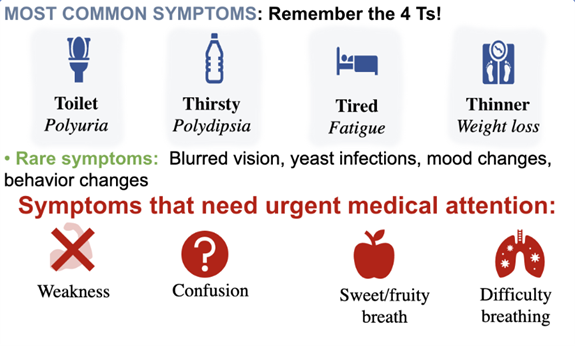
Common early signs to watch for include:
- Excessive thirst
- Frequent urination, including waking at night to urinate
- Bedwetting in a child who was previously dry
- Unexplained weight loss or poor weight gain in infants or children
- Changes in appetite
- Low energy or fatigue
Additional Symptoms:
- Blurred vision
- Yeast infections
- Mood changes
- Behaviour changes
Type 1 diabetes can present as a medical emergency, please seek immediate medical attention if your child is experiencing the above symptoms AND any of the following:
- Heavy/ difficulty breathing
- “Fruity” smell on their breath
- Muscle weakness
- Confusion/drowsiness
Symptoms of Type 1 diabetes:
If type 1 diabetes is not diagnosed and treated early, it can lead to serious complications such as diabetic ketoacidosis (DKA) and long-term health issues. DKA occurs when blood sugar levels become dangerously high due to a lack of insulin and severe dehydration. It is a medical emergency that requires immediate hospital treatment with insulin and fluids. Screening helps detect the risk of developing type 1 diabetes early and aims to prevent DKA.
Managing type 1 diabetes requires lifelong blood sugar monitoring and insulin therapy, delivered through daily injections or an insulin pump. With proper care, children with type 1 diabetes can lead full, active, and healthy lives.
In Canada, 4 in 1000 people are diagnosed with Type 1 diabetes in childhood. About 300,000 people in Canada live with the condition. You can learn more about type 1 diabetes in Canada here.
About 9.5 million people around the world live with type 1 diabetes. You can learn more at the T1D index here.
Section 3: How the Screening Works
Screening has two steps:
1. Genetic Risk Score (GRS) Screening
A sample from your child is tested to check their genetic risk of type 1 diabetes. If they are in the top 10% of risk, they will be invited for the next step. However, being at an increased genetic risk does NOT mean your child will develop type 1 diabetes. Among children with an increased genetic risk result in this study, we expect that about 97% will not be diagnosed with type 1 diabetes.
2. Autoantibody (Ab) Testing
This is a blood test starting at 12 months of age. It checks for autoantibodies. Autoantibodies are immune markers of type 1 diabetes (signs of the risk of developing T1D) that can appear years before symptoms.
What is a Genetic Risk Score? How is the Genetic Risk Score determined?
A genetic risk score (GRS) is a test that adds up many small differences in a person’s genes. These small differences can work together to increase the chance of developing a health condition, like type 1 diabetes. This GRS looks at over 100 genes linked to type 1 diabetes. The score shows if your child’s chance of developing type 1 diabetes is the same or increased compared to most people.
What sample from my child is being used in the Genetic Risk Score?
All babies in Canada have a small blood sample taken from their heel shortly after birth. This is called newborn screening, and it checks for a range of health conditions early in life. For the genetic risk score (GRS), no extra blood is taken. We use a tiny portion of the same dried blood spot that was already collected on your baby’s newborn screening card. This means the GRS does not involve another needle or blood draw for your child. We will only add the type 1 diabetes screening test to your child’s regular newborn screening test if you actively choose this option and consent to the study
A genetic risk score (GRS) is a test that adds up many small differences in a person’s genes. These small differences can work together to increase the chance of developing a health condition, like type 1 diabetes. This GRS looks at over 100 genes linked to type 1 diabetes. The score shows if your child’s chance of developing type 1 diabetes is the same or increased compared to most people.
All babies in Canada have a small blood sample taken from their heel shortly after birth. This is called newborn screening, and it checks for a range of health conditions early in life. For the genetic risk score (GRS), no extra blood is taken. We use a tiny portion of the same dried blood spot that was already collected on your baby’s newborn screening card. This means the GRS does not involve another needle or blood draw for your child. We will only add the type 1 diabetes screening test to your child’s regular newborn screening test if you actively choose this option and consent to the study
Section 4: Screening Results
Phase 1: Genetic Risk Screening
If your child has a lower genetic risk score for type 1 diabetes, that means they are unlikely to ever develop type 1 diabetes, but they could. The chance to develop type 1 diabetes in childhood after a lower risk genetic risk score is at most 1 in 1000. We expect 90% of children who complete the Genetic Risk Score to get a lower risk result.
This means that your child is in the top 10% of those most likely to develop Type 1 Diabetes. However, this is NOT a diagnosis of type 1 diabetes, and we expect the majority of children (97%) with an increased risk result from the genetic risk score will NOT go on to develop type 1 diabetes. You will receive more information about this result from a genetic counsellor. Your child will also be invited to the second phase of the screening program: autoantibody testing.
Phase 2: Autoantibody Screening
- 0 autoantibodies: Your child is currently at a lower risk for developing type 1 diabetes. This does not guarantee your child will never develop type 1 diabetes. Autoantibodies can still appear later in childhood or adolescence. If your child had an increased risk GRS, they will be offered annual autoantibody screening. If your child has only had autoantibody screening, additional autoantibody screening will be offered at age 5-6 or age 10-11. This testing will be offered once and will occur two years after their initial test. Testing will only be offered until March 1, 2029, the projected end of the study. If no antibodies are detected by age 10, the child is very unlikely to ever develop type 1 diabetes.
- 1 autoantibody: Your child’s risk for developing type 1 diabetes in their lifetime is higher than children with 0 autoantibodies. This does not guarantee that your child will or will not develop type 1 diabetes. Additional autoantibodies can still appear in childhood or adolescence. Your child will be offered repeat autoantibody screening every year.
- 2 or more autoantibodies: Your child has early-stage type 1 diabetes. Their immune system has started attacking insulin-producing cells. Most children with two or more autoantibodies will develop type 1 diabetes within 10 years, and nearly all will develop it at some point in their lifetime. This means that the lifetime risk of developing clinical type 1 diabetes is very high – close to 100%. At this stage, your child’s blood sugar levels are still within the normal range, and insulin treatment is not yet necessary. Your child will not show symptoms at this stage.
Type 1 diabetes (T1D) cannot be prevented, and nothing a parent or child does causes it. It is no one’s fault. It develops for reasons outside anyone’s control. Knowing your child’s risk early can help avoid serious illness, like diabetic ketoacidosis (DKA), and allow for earlier treatment when needed. Research is working to develop treatments to prevent or delay T1D.
You will be offered confirmatory testing and offered follow-up through a metabolic monitoring program. You may work with your healthcare provider to develop a monitoring or treatment plan. Emerging approved therapies may help delay disease progression (depending on eligibility). You may be eligible to join clinical trials through BreakthroughT1D, TrialNet [link], or Connect1d. Families may also access support networks like CommuniT1D [link] and Breakthrough T1D Canada.
Metabolic monitoring means having checks of your child’s blood sugar levels every 6 (or 12) months. This could be done in different ways, (e.g. a finger prick at home, a blood test in a lab, or perhaps using a CGM (continuous glucose monitor device)). For children with 2+ autoantibodies, these checks help find early signs of diabetes before symptoms appear, so care can start promptly.
Treatment with insulin must be started if blood sugar levels are too high. The time frame between early stage T1D diagnosis and high blood sugar levels varies from person to person and can range between months to several years.
How could this study affect my child’s ability to get insurance?
The study results will not be shared without your permission.
If you choose to share the results with your child’s doctor, they may be added to your child’s medical record. Insurance companies may ask to see medical records, and medical care resulting from these research results, such as diagnoses, treatments, or other follow-up care could be used when deciding if a person is eligible for life, health, or travel insurance.
Does participating in this study affect provincial health care coverage?
No. Participation in this study does not affect provincial health care coverage.
What is the Genetic Non-Discrimination Act (GNDA)?
Le programme de Genetic Non-Discrimination Act (GNDA) is a law in Canada. It protects people from unfair treatment because of genetic test results.
Insurance companies cannot make you take a genetic test or ask for genetic test results.
These protections apply only to genetic tests that look at DNA, RNA, or chromosomes.
What health information can insurance companies ask for?
Insurance companies can ask for regular medical records and nongenetic test results. This helps them decide if a person is eligible for life, health, or travel insurance.
In Canada, according to the Genetic Non-Discrimination Act, genetic information cannot be demanded by your insurance company or used to make insurance decisions. This means that insurance companies cannot use the results of the genetic risk score. You may access this link for more information.
However, there are some things that insurance companies can access. The Genetic Non-Discrimination Act does not cover autoantibody testing results. Also, health information – such as medical records and test results – may be released to insurance companies during an initial risk assessment. You may also be required to disclose an accurate family history. Your insurance company may use this information to assess the risk of insuring you and set premiums accordingly. In this research study, your information will not be released without your consent. However, if you are being seen by your healthcare team for early-stage type 1 diabetes metabolic monitoring (2 autoantibodies or more) then this would form part of your healthcare records, which could be accessed by your insurance company.
This information is provided for informational purposes only and does not offer personalized medical or legal advice. Under Canadian law, the Genetic Non-Discrimination Act (GNDA) makes it illegal for insurance companies to require you to take a genetic test or to disclose the results of your genetic tests, as a condition for receiving services or specific terms. These protections apply only to genetic tests that analyze DNA, RNA, or chromosomes. There are no equivalent legal protections for information contained in medical records, or for the results of non-genetic tests (including antibody tests) that form part of your child’s clinical care. Insurance companies may request this type of medical information and use it as part of their standard risk‑assessment process. In this research study, your information will not be released without your consent. However, if you choose to discuss certain research findings with your child’s physician, those findings may be documented in your child’s medical record. If that occurs, this information could affect their eligibility for life insurance in Canada, and in other countries may affect their ability to obtain health or travel insurance.
Risks are very low and similar to the risks of regular blood draws. Some children may feel brief discomfort. There is also a chance of emotional stress and anxiety if someone does have an increased risk of type 1 diabetes. Other risks include false positives and false negatives, as screening is never definitive. However, positive results will be validated with confirmatory testing, and this screening method has been rigorously tested.
Participation is entirely voluntary in a research study. You can withdraw at any time and not take part in further autoantibody testing. Please inform the research coordinator or healthcare provider that is assisting your child before withdrawing.
After autoantibody screening/testing, your child’s sample could be stored in a biobank following antibody screening/testing. The purpose of this biobank is to securely collect, store, and manage biological samples and associated participant data obtained from research participants of the CanCHECK-T1D Pilot Study for use in future ethically approved research. The biobank aims to support future studies aimed at improving the understanding of Type 1 Diabetes (T1D) risk, early disease processes, prevention strategies, and outcomes in children. Having your child’s sample included in the biobank is optional. For more information about the biobank, please consult a study coordinator using the contact info below.
You or your healthcare provider can talk to the study coordinator.
Name (study research coordinator): xxxxx xxxxx
Phone number: xxx-xxx-xxxx
Email: xxxxx@xxxxx.ca
Some families may feel worried, stressed, or anxious when learning about their child’s risk of developing type 1 diabetes. Our team is here to answer your questions and provide support.
Name (genetic counsellor): _________________________
Phone number: xxx-xxx-xxxx
Email: xxxxx@xxxxx.ca
For additional support, contact your primary healthcare provider or dial 811 to call your provincial health information network to access local sources of support or counselling.